
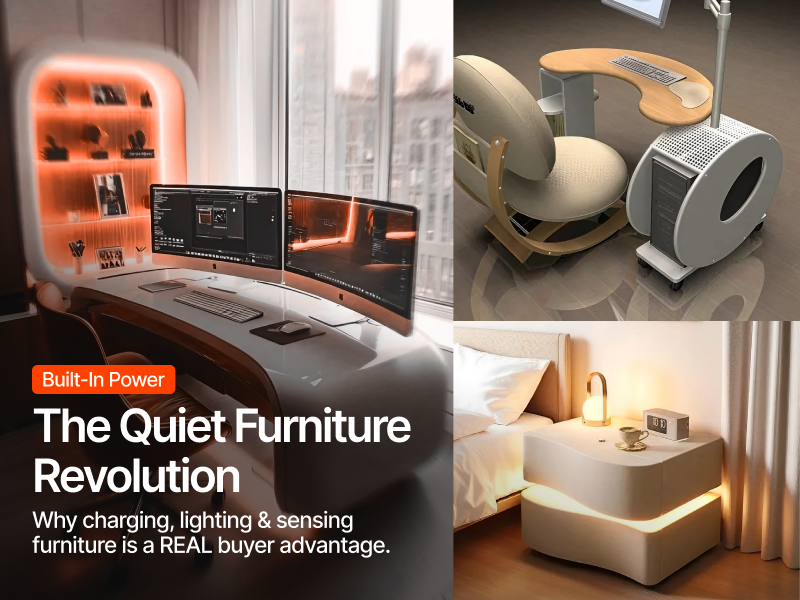
Why furniture that charges, lights and senses is no gimmick — it’s a buyer’s secret weapon
Put away the sci-fi goggles. Embedded power isn’t robots in sofas — it’s the tidy little electronics that quietly make guest phones charge, showroom demos work, and specifiers smile. At Hive, this is not a stunt to gather likes — it’s a procurement lever you can pilot, measure and sell. Below: the quick story, the practical wins, and the one-page playbook procurement will actually read.
Small tech. Big convenience.
Picture a hotel bedside table that tops up a phone without cables, a public bench that
powers USB ports and LED lighting, or a lounge chair that feeds occupancy sensors so housekeeping knows when to clean. That’s embedded power: a harvester (thin solar film,
kinetic tiles, or RF scavengers), a buffer (small battery or supercapacitor), and an output (Qi pad, USB socket, or low-power sensor). It’s subtle, useful, and—most importantly—
solves everyday pain points people actually complain about. IKEA proved the mainstream appetite years ago when it rolled Qi wireless charging into lamps and bedside tables,
showing the idea sells.
The market nudge (short and relevant)
There’s runway for this: regional demand is strong. The UAE home-decor market reached
USD 3,762.7 million in 2024, and the wider Middle East furniture market is similarly
substantial and growing—so product upgrades that add measurable value have buyers
waiting
What actually works today (no hype)
If it doesn’t survive a week in a hotel or a store, don’t show it to procurement. These three
pilots are actual deployables:
- Qi bedside tables — reliable, immediate, and noticed by guests (IKEA’s early rollout validated consumer demand).
- Solar-backed benches (outdoor) — standalone benches with PV, USB/wireless charging and lighting: high PR value and measurable usage. Municipal pilots and suppliers are shipping these now.
- Sensor-powered furniture — scavenged energy (thin PV, tiny harvesters) powering occupancy and usage sensors that reduce unnecessary cleaning and inform operations dashboards.
These aren’t moonshots — they’re low-risk pilots that translate into better guest reviews, longer showroom dwell times and cleaner operations.
The spec checklist (what procurement will actually ask)
Procurement doesn’t want poetry. They want answers. Have these ready:
Power budget — expected charge events/day and target device type (phone vs tablet).
Output & uptime — mW under realistic indoor lux; buffer battery size; mains fallback.
Standards & safety — Qi / WPC certification for wireless; UL/CE for batteries.
Maintenance plan — battery swap cadence, cleaning schedule, warranty.
Pilot KPIs — charge uses/day; % of users interacting; incidents per 1,000 uses.
Start with a 30–90 day pilot, measure the KPIs and let the data do the selling.
The honest limits (so you don’t oversell)
- Power is modest and intermittent. Indoor thin-film PV and kinetic harvesters produce small, often bursty output—great for sensors and trickle charging, not for powering kettles. Design to assist, not replace mains.
- Cost & service overhead exist. Electronics, batteries and waterproof housings add cost and lifecycle work—factor this into TCO.
- Regulation and safety matter. Use certified modules and follow WPC/Qi guidance for wireless power; consider EM and battery rules for installations. New standards (Qi2 and Ki for higher-power kitchen surfaces) are evolving—watch them but don’t bet everything on next-gen tech yet.
How to win at HIVE (the one-slide approach)
Bring one thing that works. A single, functioning demo — a Qi table or solar bench — is worth ten speculative slides. Ask procurement for a simple pilot: “Try it 30 days; we’ll measure X, Y and Z.” Host a VIP preview so buyers test in a quiet setting. Hand over the spec checklist and the maintenance plan. Small, confident pilots beat big promises.
The fun bit: where creativity meets procurement
Want spectacle? Power demos are great for attention: a piezo or TENG demo that lights an LED wall as people interact is shareable and memorable. But pair the spectacle with procurement language—uptime, maintenance and KPIs—so the joke becomes the pilot’s sales argument. Academic work on piezo and triboelectric nanogenerators (TENGs) shows the tech is progressing fast—excellent for demos and sensor power—even if it’s not yet a phone-charging silver bullet.